Posts

Monthnotes: carbon removal, COP26 IP, corporate culture
Image
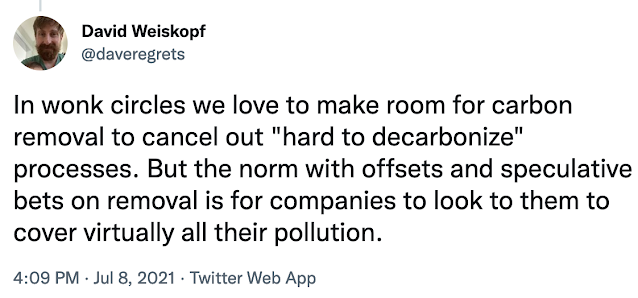
DW has a great article about the sustainability of wind power - covering all the aspects from recycling turbines, to bird fatalities, to mitigations such as "a ring of tiny air bubbles used during construction activities that dampens noise by around 90%". Thanks to Joanna Bryson. Laurie Macfarlane writes about land . Highlights mine. Although there is much hype around the promise of impressive Negative Emissions' Technologies (NETs), such as carbon capture and storage, to date the only proven NET is the restoration of forests, peatlands and other natural carbon sinks. ... In the case of carbon emissions, the approach enables those who invest in projects that will sequester carbon from the atmosphere to claim carbon credits (or carbon ‘offsets’), which can either be ‘netted off’ against the owner’s emissions, or sold on to other emitters via emissions-trading schemes. ... over the past decade, a number of large-scale emissions-trading schemes have been establi...

last-month Notes: voting, health and tech, ruggedising

Image
David Runciman in the Guardian argues for lowering the voting age - to six: There is now a set of vicious circles at work. Once politicians representing older voters start winning elections time and again, the young are discouraged from voting, which only makes the political imbalance worse. If young people pursue social mobility by moving to places where other young people are, they increase the likelihood that older voters will dominate electoral outcomes everywhere else. The result will be governments and policies that work against the sorts of social mobility that younger voters tend to favour. This has been the pattern in Britain for the best part of a generation. Pensions will get protected while student debt goes unaddressed. The interests of mortgage payers will be prioritised over the interests of renters. A country in which more than 70% of the under-30s voted to remain in the EU will still choose to leave. Three posts about MySociety and where they are going next - really p...

Notes: energy, local government, open, social enterprises

Image
 The other COP was last month: https://twitter.com/UNBiodiversity/status/1448189233026437120 I enjoyed the Talking Politics episode with Jason Bordoff , on the energy transition. The scale of the big changes needed and how challenging it is to see how they could be made quickly - outside the shift in consumer choices side of things - is fascinating. Jason notes that we cut emissions with pandemic lockdowns, but that carbon emissions need to reduce by more than they did in 2020, every year for 10 years.  Affordability of energy is a real tension too, as gas and oil necessarily get more expensive.  Microsoft has been striving to go carbon negative; it did an RFP for a huge volume of negative emissions, and found very few indeed met its criteria for good quality removal ( Nature article ): First, the supply of solutions capable of removing and storing carbon viably is a tiny proportion of that needed to reach global net-zero emissions by 2050 (which is an anticipated 2–10 ...

Notes: shortages, skills, startups, short-termism

Image
Turns out there's shortages of random items in the US as well as the UK. Matt Stoller writes about why, identifying 5 factors - monopolies manipulating price and supply, a lack of interoperability so products can't be substituted, machinery which can only be repaired by one company, infrastructure monopolies that are vulnerable to shocks through location or optimisation for efficiency at the cost of resilience, and power buyers cutting out other purchasers. There are shortages in everything from ocean shipping containers to chlorine tablets to railroad capacity to black pipe (the piping that houses wires inside buildings) to spicy chicken breasts to specialized plastic bags necessary for making vaccines. Moreover, prices for all sorts of items, from housing to food, are changing in weird ways. Beef, for instance, is at near record highs for consumers, but cattle ranchers are getting paid much less than they used to for their cows. ... The lack of resilient supply chains...