Posts

New challenges ahead

Image
TLDR; I'm very excited to be starting a new job on 1st May, where I'll be actively building tech products again, and which is a great fit for me. I'm joining lowRISC , an open source hardware non-profit, using collaborative engineering to create high quality, secure and flexible silicon designs. This is a really exciting opportunity on many levels - a chance to be part of a new wave of fundamental computing innovation enabling specialised silicon chips, to learn about the practicalities of shared engineering resource and IP at the hardware layer, and to actually ship some useful products (hopefully at reasonable scale). This may seem an unlikely step for me, on top of a possibly disparate-seeming work history , but fits nicely into  responsible delivery of practical systems using emerging technologies,  which is how I think of my work. I've been lucky enough to do this in a variety of contexts and with different technologies too. I'm starting at 4 days a week at...
Weeknotes: software sustainability in various forms

This week's most exciting update is that I've been awarded a  Software Sustainability Institute Fellowship , to help me continue to connect emerging communities interested in different forms of maintenance (digital, physical, infrastructure, commons/public goods), and across regions. I'll be using the Fellowship to support the 2019 Festival of Maintenance , and to build links between the emerging UK cross-sector maintenance community and new American communities around TheMaintainers.org . Excitingly this means I'll be able to attend  Maintainers III , and I'm interested in talking to anyone who would like to put in a collaborative proposal, either about maintenance issues across sectors or international perspectives. (We've got some great speakers signed up for the Festival in Liverpool later this year and will be announcing them soon. You can buy tickets online now , or support the Festival with a donation .) The Fellowship also gives me a reason to keep e...

Weeknotes: technical debt and the fourth industrial revolution

Image
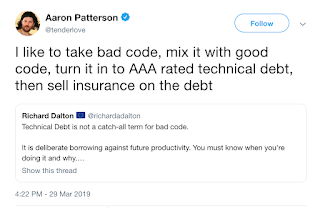
Technical debt came up a couple of weeks ago , with an interesting article about how Wikimedia was addressing it. We also had a good chat about it on a Festival of Maintenance planning call, starting from a question of how big software systems maintenance issues might differ from open source software maintenance issues. John Grant contrasted 'traditional' software technical debt, and questions where, say, legacy IT systems are still in place where competitors have moved equivalent services to the cloud - "toxic IT."  Inspired by questions from other Festival volunteers (many of whom are not into software) I wondered whether other engineering fields had a concept of technical debt. https://twitter.com/tenderlove/status/1111664818140794880 It's a term I'd only ever encountered in software, and to some extent seemed to be linked to a sense of how code is special and different to other forms of engineering, because you can "always change it later,"...

Weeknotes: mundane technology, commons based peer production, communities of co-operative practice

Image
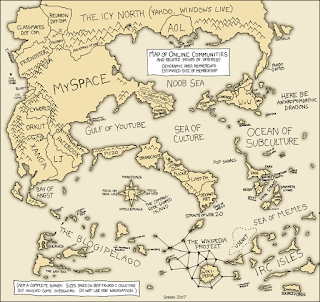
A great analysis from Apache, of the Apache open source way to reach sustainable open source success - breaking down the mission statement and looking at each piece in depth. A really important and useful clarifying piece, which also highlights how much it matters to be clear about what you are doing, for which community. The mission of the Apache Software Foundation (ASF) is to provide software for the public good. ....Investopedia defines a public good as "a product that one individual can consume without reducing its availability to another individual, and from which no one is excluded." On the surface, this is a good definition for our use of the term. However, there is a nuance in our use. Our mission is not to produce "public goods" but to "provide software for the public good".  A lovely article from Ingrid Burrington on how the internet acquires the trappings of the nation state , with borders and mapping, and also on mapping the internet. Bu...

Weeknotes: old things, bandwidth, AI, social networks

Image
On older things: A great article about what happens to old (or older) coders . Where do they go? (Thanks to  Garry Bodsworth ) I am committed to a lifetime as a programmer, but my career path for the decades to come is not well-marked. I know disturbingly few engineers older than me whose examples I can follow. Where have all the older coders gone, and what are the career prospects for those of us who remain? Having had some little insight into the world of archive libraries a decade ago, I was fascinated by this article about "data hoarders" - the more informal digital archiving community. (HT Peter Bihr) Many people active in the data hoarding community take pride in tracking down esoteric files of the kind that often quietly disappear from the internet—manuals for older technologies that get taken down when manufacturers redesign their websites, obscure punk show flyers whose only physical copies have long since been pulled from telephone poles and thrown in the t...

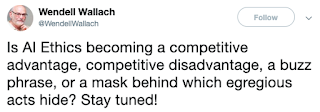
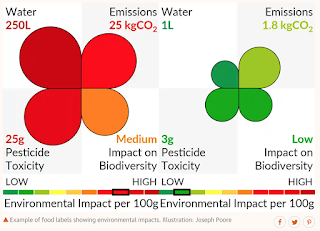
Weeknotes: interdisciplinary ethical AI, food+environment, public assets, misc tech bits

Image
A real highlight this week was a talk by Luke Church and Sharath Srinivasan of Africa's Voices Foundation . It is a rare delight to see a genuinely interdisciplinary presentation, combining computer science  and social science perspectives - and to have speakers recognise that the audience likely understood terms such as 'integrity' very differently. Both speakers brought critical reflections on their own fields. Luke spoke of the moral toxicity of the tech industry; Sharath of how, to scale social research, practitioners shift the interpretive burden to others, 'instrument' research subjects, or abstract away the inescapable role of interpretation, and take data as fact. Social science methods are political, material, self-interested and pragmatic. On the other hand, tech and data methods (at least as practised by most of the tech industry) are covertly political, essentialist, capitalist. Such methods seek to reduce or clean reality into formalisms; and then rei...