Posts

Weeknotes: open source, information maintenance, next weekend fun

Being back in open source, work on funding it is especially interesting.  Nadia Eghbal writes about the different motivations of funders of open source - corporates, who want technical outputs and brand association, compared to individuals who value the work of others as an inspiration and as training material . Pia Mancini compares GitHub Sponsors to OpenCollective - a useful breakdown of different ways to go about supporting open source maintainers. AndrĂ© Staltz has made an analysis of what funding to a selection of open source projects looks like compared to a 'fair salary' for the maintainers involved, and an interesting critique of what parts of the FOSS ecosystem funding world are visible or not. I hadn't realised TideLift (an open source subscription platform) were VC backed - I wonder how they plan to generate the revenue/exit that will require. A reflection on the vogue for tidying, and Marie Kondo, and modern life : The idea that everything must be subj...

Weeknotes: maintenance, open government, land and climate

Image
A great listen with many Festival of Maintenance friends - BBC Analysis looking at Maintenance .  We're being mis-sold a culture of innovation, and forgetting how essential looking after things is. Maybe we can have more positive framings - less make do and mend, more make the best of what we have - and make it better. Also check out this long but lovely piece from last year by Shannon Mattern (who is speaking at this year's Festival of Maintenance) - I love the themes of dust, and rust. https://www.bbc.co.uk/sounds/play/m0005mrj Zeynep Tufekci on how we tell individual stories rather than social ones: In fact, the souring of Game of Thrones exposes a fundamental shortcoming of our storytelling culture in general: we don’t really know how to tell sociological stories. At its best, GOT was a beast as rare as a friendly dragon in King’s Landing: it was sociological and institutional storytelling in a medium dominated by the psychological and the individual. A new tool...

Latenotes: open IP, roadmaps, re-engineering humanity, and the challenges of sustainable design

Image
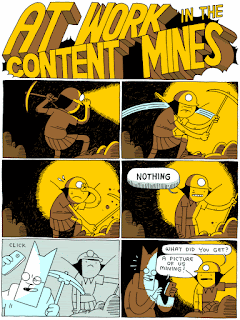
Turns out having a new job significantly delays writing things. But here we are, with a backlog. http://catandgirl.com/at-work-in-the-content-mines/ I've been reading a recent issue of the Journal of Peer Production , which focusses on open (starting with some reflections on the journal's development).  One article dives into open hardware , and particularly looks beyond the common forms (electronics, mechanical) to see what open means in other areas - such as larger scale equipment, or architecture - and how you might assess and reason about this. Sadly doesn't dive down to the silicon layer... In software --- Analytically, the more distributed, informal and open organizations tend to produce the more modular codebases. On the contrary, the more centralized, hierarchical and closed organizations produce more monolithic software.  What does this mean for hardware? Francesca Pick writes about the tensions between chaos and order for emerging organisations . ...

Inaugural meeting of 2019 Software Sustainability Institute fellows

Image
On Tuesday I was up at the University of Manchester for the first meeting of the 2019 Fellowship. The Institute gave us a great introduction and it was good how much they were keen to hear from us what we needed by way of support. 2019 event Most of the day was taken up with short talks from all the Fellows.  Some particular highlights for me: Lucy Whalley talked about getting research software published, as a way to get recognition for coding and raise the importance of software outputs. The Journal of Open Source Software  is designed to support both good software practice and good research. Ben Krikler has coined the term "hackshop" for a combined workshop and hackathon, taking place over a few days, with mixed ability attendees. He's been thinking about doing one on FPGA programming, and also about remote hackshops to reduce carbon emissions. I'd love to see more remote events - not just because of carbon-intensive travel, but also because in person ev...

New challenges ahead

Image
TLDR; I'm very excited to be starting a new job on 1st May, where I'll be actively building tech products again, and which is a great fit for me. I'm joining lowRISC , an open source hardware non-profit, using collaborative engineering to create high quality, secure and flexible silicon designs. This is a really exciting opportunity on many levels - a chance to be part of a new wave of fundamental computing innovation enabling specialised silicon chips, to learn about the practicalities of shared engineering resource and IP at the hardware layer, and to actually ship some useful products (hopefully at reasonable scale). This may seem an unlikely step for me, on top of a possibly disparate-seeming work history , but fits nicely into  responsible delivery of practical systems using emerging technologies,  which is how I think of my work. I've been lucky enough to do this in a variety of contexts and with different technologies too. I'm starting at 4 days a week at...

Weeknotes: software sustainability in various forms

This week's most exciting update is that I've been awarded a  Software Sustainability Institute Fellowship , to help me continue to connect emerging communities interested in different forms of maintenance (digital, physical, infrastructure, commons/public goods), and across regions. I'll be using the Fellowship to support the 2019 Festival of Maintenance , and to build links between the emerging UK cross-sector maintenance community and new American communities around TheMaintainers.org . Excitingly this means I'll be able to attend  Maintainers III , and I'm interested in talking to anyone who would like to put in a collaborative proposal, either about maintenance issues across sectors or international perspectives. (We've got some great speakers signed up for the Festival in Liverpool later this year and will be announcing them soon. You can buy tickets online now , or support the Festival with a donation .) The Fellowship also gives me a reason to keep e...

Weeknotes: technical debt and the fourth industrial revolution

Image
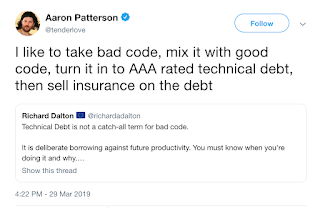
Technical debt came up a couple of weeks ago , with an interesting article about how Wikimedia was addressing it. We also had a good chat about it on a Festival of Maintenance planning call, starting from a question of how big software systems maintenance issues might differ from open source software maintenance issues. John Grant contrasted 'traditional' software technical debt, and questions where, say, legacy IT systems are still in place where competitors have moved equivalent services to the cloud - "toxic IT."  Inspired by questions from other Festival volunteers (many of whom are not into software) I wondered whether other engineering fields had a concept of technical debt. https://twitter.com/tenderlove/status/1111664818140794880 It's a term I'd only ever encountered in software, and to some extent seemed to be linked to a sense of how code is special and different to other forms of engineering, because you can "always change it later,"...

Weeknotes: mundane technology, commons based peer production, communities of co-operative practice

Image
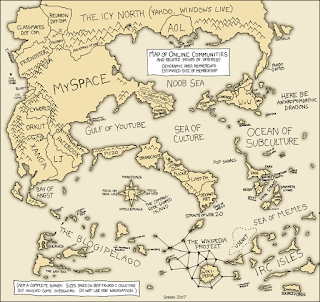
A great analysis from Apache, of the Apache open source way to reach sustainable open source success - breaking down the mission statement and looking at each piece in depth. A really important and useful clarifying piece, which also highlights how much it matters to be clear about what you are doing, for which community. The mission of the Apache Software Foundation (ASF) is to provide software for the public good. ....Investopedia defines a public good as "a product that one individual can consume without reducing its availability to another individual, and from which no one is excluded." On the surface, this is a good definition for our use of the term. However, there is a nuance in our use. Our mission is not to produce "public goods" but to "provide software for the public good".  A lovely article from Ingrid Burrington on how the internet acquires the trappings of the nation state , with borders and mapping, and also on mapping the internet. Bu...