Posts

Fortnightnotes: bullshit jobs, business and inequality, open source

Image
David Graeber (of Bullshit Jobs fame) spoke at Chaos about managerial feudalism and the caring classes . It's a great talk, describing how everyday people's experience of the workplace is shaping their choices in politics and around Brexit.  He also talks about our focus on production activities, using a nice example of a teacup - you make it once, but use it for service and wash it many times. Graeber recurs in a recent edition of Drew Austin's Kneeling Bus : Last year, I wrote an essay for Real Life about AirPods despite not owning a pair myself at the time. That was intentional and fairly essential to the piece, as I was examining the earbuds’ externalities: how it feels to inhabit public space without an increasingly ubiquitous pair of headphones when everyone else is wearing them. If AirPods offer a near-perfect user experience to the users themselves, what kind of user experience do they impose upon the non-users? (That’s a good question to ask about many things, ...

Yearnotes: 2019

Image
Last year's thoughts on weeknotes basically still stand: One thing my weeknotes show clearly is that each week there are diverse topics catching my eye, and although I can probably sketch out a few recurring themes, they are all happening in parallel — and most of them are not topics I am actually working on, in a paid sense. There’s not been the clear blocks of time to synthesise any one of these strands, or sufficient bits of time to work through them with others, as I generally think better with others. Seen at Doteveryone's new office: https://www.instagram.com/p/B5dUD_cpwHv/ A lot of last year's yearnotes still stand, too. So what changed in 2019? I left the Trust&Technology Initiative in good hands, but stayed on at the Department of Computer Science and Technology at Cambridge to help as an interim with industry collaborations and miscellaneous research facilitation things. By December a new research strategy manager had started and I was able to han...

A decade in phones

Image
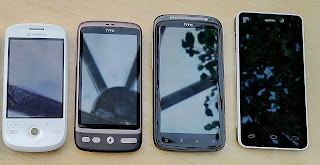
Or nearly a decade in phones, as this is missing the two most recent phones: I had the Vodafone from 2009, so started the decade with that. The little joystick thing was good, but otherwise it was an annoying phone after 3 Nokias with physical keypads. The two HTCs were better. The Fairphone 1 was shortlived and aged rapidly (at least with my level of app usage); I was delighted to replace it with the Fairphone 2, which weathered changes in Android much better. I did have a second FP2 handset, after the first one hit early adopter bugs and needed to go back for debugging. Overall it was nearly 4 years before I changed phone again. My FP2 is not shown, as it went back for refurbishment; I now have a Fairphone 3, which is a really excellent piece of hardware, recommended. We'll see if it lasts the seven years Fairphone hope to support it for! All these phones had/have very similar user interfaces - a portrait rectangle screen you poke at (or swipe, these days), icons, apps...

Fortnight notes: Fame, blame, protest, digital bits, towns

Image
A recent edition of the Kneeling Bus looks at the void left behind when products and services cease to be. Blockbuster went away, but was replaced by Netflix etc, arguably improvements. Spotify has replaced CDs, and many people don't have them any more. If/when Spotify goes away, will there be something better? Several people linked to this New Republic article on the internet and climate change . A good mix of necessary responses (resilient local mesh networks for times when extreme weather damage conventional infrastructure), and thought-provoking stats - streaming "one hour of Netflix a week requires more electricity, annually, than the yearly output of two new refrigerators." We’ve grown used to communicating in videos, memes, and animation. Most websites are packed with video players, blaring banner ads, pop-ups, elaborate layouts. But the glut of data costs actual energy. And do we actually need any of it? “Streaming could easily be 10 percent of global electri...

Monthnotes: premodern internet, technical debt, ageing/longevity

Image
Maybe we've had the wrong visions of the future, argues Max Read . What if we aren’t being accelerated into a cyberpunk future so much as thrown into some fantastical premodern past?  This article covers bewitched 'smart' objects and the feudalism of big tech platforms: Looking around lately, I am reminded less often of Gibson’s cyberpunk future than of J.R.R. Tolkien’s fantastical past, less of technology and cybernetics than of magic and apocalypse. The internet doesn’t seem to be turning us into sophisticated cyborgs so much as crude medieval peasants entranced by an ever-present realm of spirits and captive to distant autocratic landlords. What if we aren’t being accelerated into a cyberpunk future so much as thrown into some fantastical premodern past? The article gives many examples, such as: And as the internet bewitches more everyday objects — smart TVs, smart ovens, smart speakers, smart vibrators — its feudal logic will seize the material world as well. Yo...