Posts

Fortnightnotes: Tesla coils, miscellany

A highlight from this year's Wilderness Festival was Arcadia Spectacular - a small portion of the show was Lords of Lightning . Lords of Lightning - Musical Tesla from Arcadia Spectacular on Vimeo . Looking forward to more Tesla coil action at Wuthering Bytes festival day in a couple of weeks - as ever, a stunning line up of talks on all kinds of science, tech and culture topics. Grab a ticket now and join us in Hebden Bridge for the most authentic tech festival in the UK! An interview with Martin Kleppmann, on formal verification and distributed systems . Formal verification is one of the bits of computer science I think is least well known in the wider 'digital' world; this is regrettable, as it is one approach to tackling some of the problems people encounter with computer systems. It's been great to work slightly with Martin whilst at the Computer Lab in Cambridge. A study finds "older drivers aged 55-75 removed their eyes and attention from the ...

Fortnight notes: definition of done, funding social sector tech, open data, dreaming devices

Image
Doteveryone has published our "definition of done". What does it mean to finish a piece of work?  What does good advocacy, protest or resistance work look like now? It turns out clear communication is important. Don Norman on replacing "Yes, and" with "Yes, but, and" - Note that the “but” anticipating the “and” is essential. In order to build on your idea, your colleague does not just add a new improved proposal. First, she provides a critique, which enables you to receive precious and specific information, see weaknesses in your half-backed idea you couldn’t spot yourself, and therefore learn. You and the entire team will then be ready to dive deeper into the next iteration. It is the combination of “but” and “and” that creates real progress, enabling the team to see both positive and negative components and allowing each iteration to go even deeper into the analysis. Research from the Collective Impact Forum on funding for 'backbone' wor...

2019 Festival of Maintenance

Image
This year's Festival of Maintenance takes place in Liverpool on Saturday 28th September.  Maintenance is a fascinating topic, cutting across so many parts of our lives and our world, and yet often neglected in how we think about things. Last year's event was very well received and we were delighted to be covered by the BBC World Service and in the Economist, suggesting that perhaps it's the start of a new surge of interest. So the 2019 Festival is a great opportunity to find out why maintenance matters, and to explore maintenance in a complex and changing world. Tickets are just £15 and we have some great speakers and intriguing themes lined up: We start with opening talks from Donna Young, Herbarium Curator, Liverpool World Museum, on keeping dead things dead, and Ben Ward on community IoT sensor networks as a self-made burden. Climate crisis With environmental factors so certain, our built environment will require a far higher value placed on maintenance than at...

Weeknotes: design for resilience, MakeFest, fake stuff online, electricity

Image
I've had Steven Jackson's paper on repair in my reading stack for months. I think I first came across it via Lee Vinsel's Maintainers graduate seminar syllabus . It situates maintenance within socio-technical studies, examining the broken world, the role of the fixer as distinct from the user or designer in innovation, and the risks of focussing on nostalgia or heroism as frames for maintenance. Secondly, attention to maintenance and repair may help to redirect our gaze from moments of production to moments of sustainability and the myriad forms of activity by which the shape, standing, and meaning of objects in the world is produced and sustained—a feature especially valuable in a field too often occupied with the shock of the new. Via Festival of Maintenance team-mate Naomi Turner, an article by Jesse Weaver on resilience as a key design imperative for the future - because we've forgotten to do this recently. We don’t like to think about worst-case sc...

Weeknotes: open source, information maintenance, next weekend fun

Being back in open source, work on funding it is especially interesting.  Nadia Eghbal writes about the different motivations of funders of open source - corporates, who want technical outputs and brand association, compared to individuals who value the work of others as an inspiration and as training material . Pia Mancini compares GitHub Sponsors to OpenCollective - a useful breakdown of different ways to go about supporting open source maintainers. André Staltz has made an analysis of what funding to a selection of open source projects looks like compared to a 'fair salary' for the maintainers involved, and an interesting critique of what parts of the FOSS ecosystem funding world are visible or not. I hadn't realised TideLift (an open source subscription platform) were VC backed - I wonder how they plan to generate the revenue/exit that will require. A reflection on the vogue for tidying, and Marie Kondo, and modern life : The idea that everything must be subj...

Weeknotes: maintenance, open government, land and climate

Image
A great listen with many Festival of Maintenance friends - BBC Analysis looking at Maintenance .  We're being mis-sold a culture of innovation, and forgetting how essential looking after things is. Maybe we can have more positive framings - less make do and mend, more make the best of what we have - and make it better. Also check out this long but lovely piece from last year by Shannon Mattern (who is speaking at this year's Festival of Maintenance) - I love the themes of dust, and rust. https://www.bbc.co.uk/sounds/play/m0005mrj Zeynep Tufekci on how we tell individual stories rather than social ones: In fact, the souring of Game of Thrones exposes a fundamental shortcoming of our storytelling culture in general: we don’t really know how to tell sociological stories. At its best, GOT was a beast as rare as a friendly dragon in King’s Landing: it was sociological and institutional storytelling in a medium dominated by the psychological and the individual. A new tool...

Latenotes: open IP, roadmaps, re-engineering humanity, and the challenges of sustainable design

Image
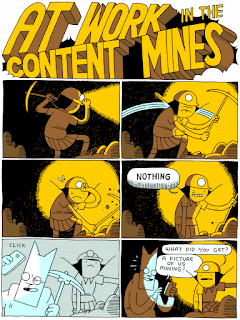
Turns out having a new job significantly delays writing things. But here we are, with a backlog. http://catandgirl.com/at-work-in-the-content-mines/ I've been reading a recent issue of the Journal of Peer Production , which focusses on open (starting with some reflections on the journal's development).  One article dives into open hardware , and particularly looks beyond the common forms (electronics, mechanical) to see what open means in other areas - such as larger scale equipment, or architecture - and how you might assess and reason about this. Sadly doesn't dive down to the silicon layer... In software --- Analytically, the more distributed, informal and open organizations tend to produce the more modular codebases. On the contrary, the more centralized, hierarchical and closed organizations produce more monolithic software.  What does this mean for hardware? Francesca Pick writes about the tensions between chaos and order for emerging organisations . ...

Inaugural meeting of 2019 Software Sustainability Institute fellows

Image
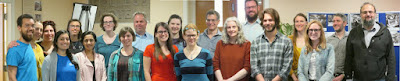
On Tuesday I was up at the University of Manchester for the first meeting of the 2019 Fellowship. The Institute gave us a great introduction and it was good how much they were keen to hear from us what we needed by way of support. 2019 event Most of the day was taken up with short talks from all the Fellows.  Some particular highlights for me: Lucy Whalley talked about getting research software published, as a way to get recognition for coding and raise the importance of software outputs. The Journal of Open Source Software  is designed to support both good software practice and good research. Ben Krikler has coined the term "hackshop" for a combined workshop and hackathon, taking place over a few days, with mixed ability attendees. He's been thinking about doing one on FPGA programming, and also about remote hackshops to reduce carbon emissions. I'd love to see more remote events - not just because of carbon-intensive travel, but also because in person ev...